
- News
- City News
- bhubaneswar News
- In Kalahandi, houses raise the wall against migration
Trending
This story is from December 12, 2019
In Kalahandi, houses raise the wall against migration
: To curb migration in Kalahandi district, the administration has started creating awareness by painting and writing on the walls of houses provided under Pradhan Mantri Awas Yojana in 2019-20 in Madanpur Rampur block, about 65 km from here.
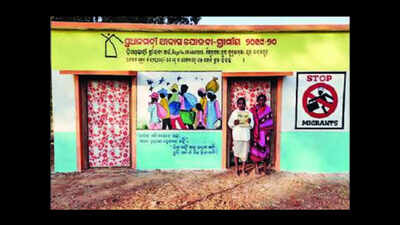
Paintings and messages adorn a house in Kalahandi district urging people against migrating

Around 50 houses out of 3,000 have got work orders and three have been completed in the block. In the first phase, a house is provided to a beneficiary at a cost of Rs 1.30 lakh and a punchline is written on the wall.
It states, “Dadan khati gale re sab-Ame hairan hebar nahi. Jiba nahi au dadan khati-chhadi ame gaon bhita mati (Everyone has gone outside as migrant worker. We don’t want to be harassed. We will not go outside in search of work any more leaving our native place)”.
The idea was implemented by block officials who hope that people will think twice before migrating. Block development officer (Madanpur Rampur) Rumana Jafri said in every panchayat walls of five houses will be painted.
There are 19 gram panchayats in the block that has a population of 80,000 and literacy rate of 57%. Besides advertising on the walls, the administration is sensitising people by organising gram sabhas.
“The block comes under ‘push factor’ where workers are forced to leave their native place owing to lack of basic amenities. There is lack of roads in the rural pockets as people live on the forested land,” she said.
Hundreds of workers migrate without registering their names in the labour office. Some go through the unregistered labour agents and some of their own accord. A labour officer requesting anonymity said it is tough to stop them because the workers are lured by the agents whereas most of them return home after being tortured by the owners.
“The government implemented schemes like National Rural Employment Guarantee Act, which ensures 200 days works a year in the rural pockets but practically they don’t get job locally. That’s the main reason behind migration,” said Dilip Kumar Das, director of an NGO. Some people die and some lose their limbs while working in Tamil Nadu, Kerala, and Maharastra, Das added. He said in the past migrants have faced problems to bring back the body of dead workers.
“Cases have been filed with human rights organisations or in police stations. The body is then handed over to the family members of the deceased after lot of paper work. In some cases, poor workers are held captive for a long time by ‘labour agents’, who ask them to return the advance money taken from him,” said Das.
If migration has to be checked, then the government needs to provide all facilities to the poor like ensuring employment, communication, electricity, drinking water, health and education along with bridges over many rivers. There are hundreds of villages that need to have proper communication facilities, Das added.
End of Article
FOLLOW US ON SOCIAL MEDIA






Hot Picks
TOP TRENDING
Trending Stories
In City
Entire Website
- Diljit Dosanjh’s Dil-Luminati India Tour: Check dates, venue, how to book concert tickets online
- Hamster Kombat Daily Cipher Codes and Combo Cards for September 13, 2024: Unlock up to 1 million coins
- Narayana Murthy faces backlash for parenting remarks on social media; users say, "after working 72 hours a week, there’s barely time left to have babies…”
- Shreyas Iyer comes out to bat wearing sunglasses, falls for a duck in Duleep Trophy
- iPhone 16 will be available for Rs 54,900 on Apple website; here's how you can grab the deal
- iPhone 16 to go on pre-order today: Pre-booking details, time, sale date and more
- Vande Metro launch date, schedule: PM Modi to flag off Bhuj-Ahmedabad Vande Metro train; check timings, stoppages of new Indian Railways train
- Why around 40,000 TCS employees have received tax demand notices for Rs 50,000 to over Rs 1 lakh
- Bill meant to usurp Waqf land, JPC told
- Delhi to UP: IMD releases forecast and issues warnings across several states
- 'My father was on the flight': EAM opens up about '84 Air India hijack
- 'My resolve has grown 100-fold': Kejriwal walks out of Tihar jail
- Why Rahul should talk more about jobs and less about ideology
- Sebi chief counters Cong charges, says narrative based on illegally obtained IT returns
- Annapoorna video row: Rahul attacks Centre; Annamalai apologises
- From Duck to Delight: Iyer strikes first ball to dismiss Agarwal
- Can Sebi chief Madhabi Puri Buch survive this storm of allegations?
- Jhumka Gira Re ...: American woman's Instagram post on India goes viral
- 'Fail to understand ...': What SC said while granting bail to Kejriwal
- To do away with colonial legacy, govt renames Port Blair to...

Popular Categories
Hot on the Web
Top Trends
Aadhaar Card UpdateTech LayoffsArvind Kejriwal BailVande MetroShannon SharpeAdani HinderburgUPSC Mains Admit CardKristina JoksimovicTCS Employee Tax NoticesWay Chatgpt can be your Study PartnerAir Taxi IndiaAyushman Bharat SchemeKolkata Doctor Rape CaseDonald TrumpShreyas IyerDiljit DosanjhLive Cricket Score
Trending Topics
Alia BhattMalaika Arora Father DeathArbaaz KhanNatasa StankovicMr Bachchan OTT ReleaseNational Parks In IndiaSelena GomezGOAT CollectionVikas Sethi DeathMalayalam ProducersIndia's Best Dancer 4Simi GarewalDilli BabuIndian National ParksLaung BenefitsVikas SethiApple iPhone 16SpaceXAadhar Card Update By Sept 14Wordle Answer
Living and entertainment
Latest News
7. Hindi becomes officialSalman Khan surrounded by bodyguards as he arrives at Malaika Arora's mother's house to offer his condolences - WATCHJulie Chen to miss Big Brother live eviction for first time, taps Jerry O'Connell to hostBonedi baris hope for a peaceful start to PujoNIA raids pro-Khalistan preacher Amritpal Singh's relative's house in AmritsarA vision unfolds: How Levitation is crafting tomorrow’s enterprise solutionsPreschools turn nursing homes, retirement age raised: China's demographic crisis explodesTovino Thomas praises Prithviraj Sukumaran as director: "One of the brilliant directors I have ever worked with"Tragedy strikes at fundraiser: Mother of two dies after marshmallow-eating competitionMan shot near Delhi's Greater Kailash-I gym, gang war suspected8 animals that reproduce without mating'Cops stood as mute spectators': Protesting doctors write to President over RG Kar impasseISL-11 opener: Familiar foes back in businessFatal crash in Australia's Netherby claims life of ToddlerBiden to host fourth quad summit with PM Modi, Albanese, and Kishida in Delaware on September 21: White HouseNASA to establish New Lunar Time Standard with Coordinated Lunar Time (LTC) initiativeDivya Bansal explores themes of human resilience, love and positive transformation in debut poetry bookWWE Superstar Cody Rhodes and his Wife Brandi Rhodes Share Special Messages on Their 11th Anniversary
Copyright © 2024 Bennett, Coleman & Co. Ltd. All rights reserved. For reprint rights: Times Syndication Service